Contacts
- 4.3
- Rating
- 1.00M
- Installs
- Free
- Price

 Analysis by App-foxy
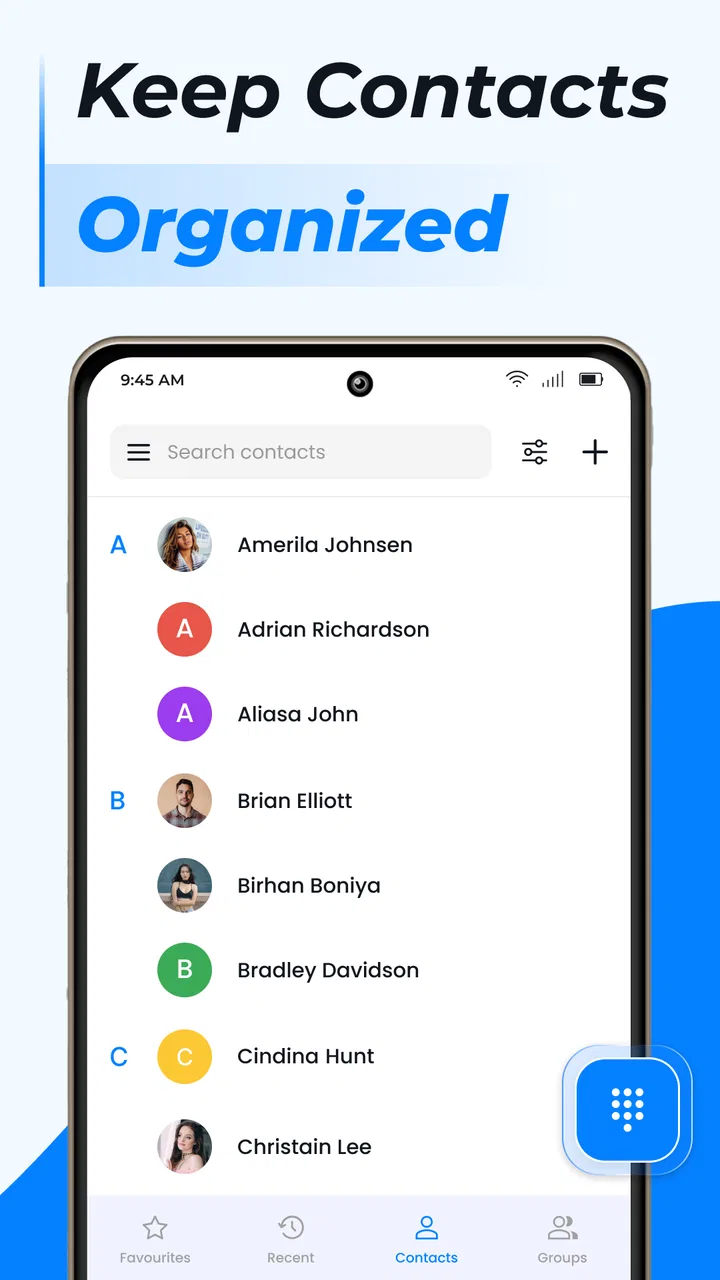
Contacts is a free communication app built around the part of a phone I use most often but usually think about least: finding people and starting calls quickly. It combines a phone dialer with an address book and contact-management tools, so the appeal is not a single flashy feature. The goal is to make everyday calling less awkward, especially when the standard phone app feels cluttered or when contacts have become difficult to search.
I reviewed it as someone who regularly moves between saved contacts, recent calls, and manual number entry. My overall impression is that Contacts makes the most sense for people who want a focused calling workspace rather than a large messaging platform. It is listed in the Communication category, is developed by Internet browser, and has a 4.3 average from around 17 thousand ratings. That gives it a useful level of public feedback without making the rating the only reason to install it.
What Contacts actually gives you for free
The clearest part of the value proposition is the price: Contacts is free to use. That matters here because a dialer and address book are utilities I expect to open frequently, not occasional entertainment. I can try it without committing money, compare its daily behavior with the phone app already on my device, and remove it if the workflow does not suit me.
You May Also Like

 Blood Strike: 2.5 Anniversary
Blood Strike’s Loadouts Turn Every Drop Into a Tactical Gamble
A close look at Blood Strike’s custom loadouts: how fast access to signature weapons reshapes its battle royale rhythm, rewards preparation, and narrows the gap between fights.

 Pandora - Music & Podcasts
Pandora’s Music Is Easy to Start, but Harder to Recover
Pandora’s strength is its low-effort path from a seed to a station. Its weak spot is how much confidence it asks you to place in connection, setup, and quiet recovery.

 8 Ball Pool
 Is Built on Rivalries, Rematches, and Routine
A close look at the rivalries, rematches, shared routines, and unanswered safety questions that turn a quick pool match into a persistent mobile community.

 Samsung Music
’s Quiet Strength Is Playing What You Already Own
Its reach comes less from spectacle than from dependable access to a personal library. That simplicity is both the app’s strongest retention engine and its ceiling.

 AccuWeather: Weather Radar
AccuWeather Review: A Quick, Clear Forecast for Everyday Decisions
For everyday plans, the best forecast is the one you can understand quickly. AccuWeather makes rain timing, radar, and local conditions easy to act on, with a few trade-offs.

 Hill Climb Racing
Why Hill Climb Racing Still Turns Crashes Into One More Run
A tiny car, a bumpy hill and one more upgrade: Hill Climb Racing keeps resurfacing because its simple chaos makes every near-miss feel personal.
More From Our News Desk



The free price also changes how I judge the app. I am not expecting a premium contact-management suite with every possible business feature. Instead, I look for speed, clarity, sensible organization, and fewer small frustrations when calling someone. On that basis, the app has a reasonable purpose. Its store summary identifies the main combination directly: a phone dialer, caller identification, an address book, and contact management in one place.
It is available to a broad audience, with an Everyone content rating, and it supports devices running Android 6.0 or later. The current version is 37.0.0, while its release date is November 26, 2022. Those details make it approachable for people using older Android hardware, although compatibility alone does not guarantee that every manufacturer’s phone behaves identically.
One point I would keep in mind before switching is that “free” does not automatically mean “better than the built-in dialer.” The real benefit has to come from the way Contacts arranges calling and contact tasks. If your existing phone app already gives you a clean search, reliable recent-call access, and comfortable editing, you may notice only a modest difference. The lack of a purchase cost makes testing easy, but it does not remove the time cost of reorganizing your habits.
A practical first-day workflow
My preferred way to evaluate an app like this is not by browsing every screen. I start with three ordinary actions: search for a saved person, enter a number that is not in the address book, and edit a contact whose details are no longer current. These actions reveal whether the app is useful beyond its store wording.
Contacts is most convincing when treated as a single front door for those tasks. Instead of thinking separately about “the dialer” and “the address book,” I can approach a call by name, number, or recent activity. That is a small distinction, but it affects how quickly I recover from a common problem: remembering the person but not the number, or remembering the number but not having saved it.
A realistic example is calling a delivery driver, repair technician, or local service that is not worth saving permanently. I can use the dialer for the immediate call, then return to the contact area when I need to update a family member’s number. That separation is useful because not every number deserves a permanent place in my address book. A contact manager should help me keep useful entries organized without forcing every short-term call into the same list.
Where the contact tools matter most
The address-book side is more important than it may first appear. Many people accumulate duplicate or outdated entries over time: an old workplace number, a second mobile number, or a contact saved under a nickname that is hard to search later. A dedicated contact-management view encourages me to treat the address book as something I maintain rather than a passive list I tolerate.
My practical tip is to edit contacts immediately after a meaningful change instead of waiting for a cleanup session. If someone changes their number, update the existing entry while the information is fresh. If a person has two useful numbers, label them clearly rather than relying on memory. This is not a dramatic feature, but it is the kind of workflow that makes a contact app earn its place over time.
Another useful habit is to search by several clues before creating a new entry. Try the person’s name, then the number, then a distinctive part of the saved information. This reduces the chance of creating duplicates simply because the original entry was not found on the first attempt. The advantage of using one app for dialing and contacts is that the transition between searching and calling feels more direct.
Caller identification and everyday confidence
Caller identification is one of the more appealing parts of the package because it can add context before I decide whether to answer. That is especially helpful when a number is not saved or when I am expecting a call but do not immediately recognize the displayed digits. Still, I would not treat caller identification as a guarantee of identity. A label can be useful context, but it should not replace judgment when a call asks for sensitive information or urgent action.
This is an important trade-off. A dialer that shows more context may make unknown calls feel easier to interpret, but the feature is only as useful as the information available to the app and the accuracy of what is displayed. I would use it as a screening aid, not as proof that a caller is trustworthy. That distinction is easy to overlook when a caller label appears confidently on screen.
For everyday use, I find the strongest benefit comes from reducing hesitation rather than transforming calling completely. Seeing a recognizable contact, reaching the address book quickly, and keeping manual dialing nearby are small improvements that add up when repeated several times a day. The app does not need to reinvent phone calls to be worthwhile; it needs to make the common path feel less scattered.
Tradeoffs before replacing the usual phone app
The first limitation is that Contacts occupies a role many Android phones already fill. The built-in dialer is usually tightly connected to the operating system, recent calls, and the manufacturer’s contact screens. Replacing it can create a learning curve, even when the alternative is straightforward. I would not switch merely because the app has a clean description. I would switch only after confirming that its search and editing flow feels faster for my own contact list.
There is also a difference between a personal address book and a more demanding contact system. For a small list of family, friends, colleagues, and regular services, a focused app may be enough. For someone managing a large professional directory, detailed business relationships, shared records, or a team workflow, a specialized contact-management service could be a better fit. Contacts is centered on phone communication, not on replacing a full customer-management system.
Another trade-off involves caller identification. I appreciate the convenience, but I would avoid making decisions based solely on a displayed name or category. Unknown callers can be mislabeled, and familiar-looking information can still be used in a dishonest call. The sensible workflow is to let the feature help prioritize attention while keeping normal caution in place.
Switching between dialers can also affect muscle memory. I know where the call button and recent calls are in my usual phone app, so any alternative must prove itself through repeated use. My advice is to test it during a calm period rather than changing the default immediately before an important call. Spend a little time searching contacts, editing entries, and returning to recent numbers. If those actions feel natural after several attempts, the change is more likely to stick.
How it compares with familiar alternatives
Compared with the standard phone app, Contacts offers a more deliberate focus on combining dialing, caller identification, and contact organization. The built-in option may still win for people who value seamless integration with their handset above everything else. Its advantage is familiarity and system-level convenience. Contacts is more interesting for someone who feels that the default experience is too basic, scattered, or inconvenient for maintaining an address book.
Compared with a messaging-first communication app, Contacts is narrower but also more direct. A messaging platform may be better when conversations, group chats, media sharing, and online presence are the main priorities. Contacts is better suited to the moment when I simply need to find a person and place a phone call. Choosing between them depends on whether the phone number remains central to the way I communicate.
Compared with a full contact-management or business tool, Contacts is easier to understand but less ambitious. A professional system may provide richer organization for work relationships, while this app keeps attention on the phone’s basic communication path. That narrower scope is not automatically a weakness. For a personal device, avoiding unnecessary complexity can be a genuine advantage.
Who will get the most value
I think Contacts is a good match for people who make regular phone calls and want their saved people, manual dialing, and contact editing close together. It is particularly sensible for users who have accumulated a messy address book and are willing to improve it gradually. The free price makes it easy to experiment, and the Everyone rating keeps the app approachable for a general audience.
It may also suit someone setting up an older Android phone that still meets the Android 6.0 minimum. In that situation, a lightweight communication utility can be more appealing than a feature-heavy alternative, provided the phone handles it comfortably. I would still judge the experience on the actual device, since screen layout, manufacturer software, and existing contact behavior can influence how natural a replacement feels.
I would skip it if your current dialer already solves everything and you rarely edit contacts. There is little reason to add another layer when your existing workflow is reliable. I would also look elsewhere if you need shared contact records, deep business organization, or a communication hub built mainly around messaging. Contacts is most valuable when its focused scope matches the problem you are trying to solve.
Small habits that make the app more useful
First, treat contact editing as part of calling rather than a separate chore. When a number changes, update the entry right away. This prevents the address book from becoming a collection of guesses and old details.
Second, keep temporary numbers temporary. If you are calling a one-time service, use manual dialing unless you genuinely expect to call the number again. This keeps the saved list useful and makes future searches less noisy.
Third, use caller identification cautiously. Let it help you decide whether a call deserves attention, but verify unexpected requests through a trusted channel. Convenience should reduce friction, not reduce awareness.
Finally, compare Contacts with your current phone app during real routines rather than judging it from a few minutes of browsing. Call a saved person, find a recent number, edit an entry, and search for a contact using incomplete information. Those tests reveal whether the app improves your day or simply changes the location of familiar buttons.
My verdict on installing Contacts
After looking at it as a daily communication tool, I see Contacts as a practical free alternative for people who want a clearer relationship between dialing and contact organization. Its strongest idea is not novelty; it is bringing several phone-number tasks into one focused place. The caller-identification element adds useful context, while the address-book tools give the app a reason to remain installed after the first call.
The limitations are equally clear. It cannot automatically be the best choice for every Android user because the built-in dialer already covers the basics well on many phones. It also should not be mistaken for a professional shared database or a messaging platform. The app works best when you need a personal phone utility, not an all-purpose communication system.
With more than one million installs and a 4.3 average, it has attracted a sizeable audience, but I would still make the decision based on your own calling habits rather than popularity alone. The free access removes the financial risk, so the sensible approach is to test the core workflow carefully. If searching, calling, and maintaining contacts feel more straightforward than they do now, the switch can be worthwhile.
My recommendation is to try Contacts if your address book feels neglected or your current dialer makes simple calls harder than they should be. I would skip it when the default phone app already feels effortless, or when your needs go beyond personal calling and contact maintenance. For the right user, it is a focused, accessible utility; for everyone else, its main value may simply be confirming that the phone app already on the device is good enough.
FAQs for Contacts
01What features does the Contacts app offer?
The Contacts app provides a comprehensive platform for managing your personal and professional contacts. It includes features such as contact grouping, customizable fields, integrated search, and synchronization with cloud services. Additionally, users can link contacts with social media profiles and set reminders for birthdays and anniversaries.
02Is the Contacts app secure for storing personal information?
Yes, the Contacts app is designed with security in mind. It uses encryption to protect your data and offers options to back up your information to secure cloud services. Additionally, the app provides privacy settings to control access and sharing of your contact details with other applications.
03How does the Contacts app integrate with other applications?
The Contacts app seamlessly integrates with various applications like email clients, messaging apps, and social media platforms. This integration allows users to initiate calls, send messages, and share information directly from the app. It also syncs with calendars to provide reminders for important dates.
04Can I transfer my contacts from other devices to the Contacts app?
Yes, the Contacts app supports easy transfer of contacts from other devices. Whether you are moving from Android, iOS, or using a CSV file, the app provides step-by-step guidance to import your contacts. It also supports synchronization with Google and iCloud for seamless transitions.
05Does the Contacts app offer customization options for managing contacts?
Absolutely, the Contacts app offers extensive customization options. Users can create custom labels, add detailed notes, and organize contacts into groups or categories. The app allows for setting custom ringtones and alerts for specific contacts, making it easier to personalize your communication experience.
Pros
- User-friendly interface with intuitive navigation.
- Seamless integration with cloud services.
- Efficient search and filter options.
- Customizable contact groups and labels.
- Smart suggestions for duplicate contacts.
Cons
- Limited theme customization options.
- Occasional syncing issues with some accounts.
- Ads can be intrusive in free version.
- No direct support for business cards scanning.
- Requires frequent updates for optimal performance.

Contacts
Gallery